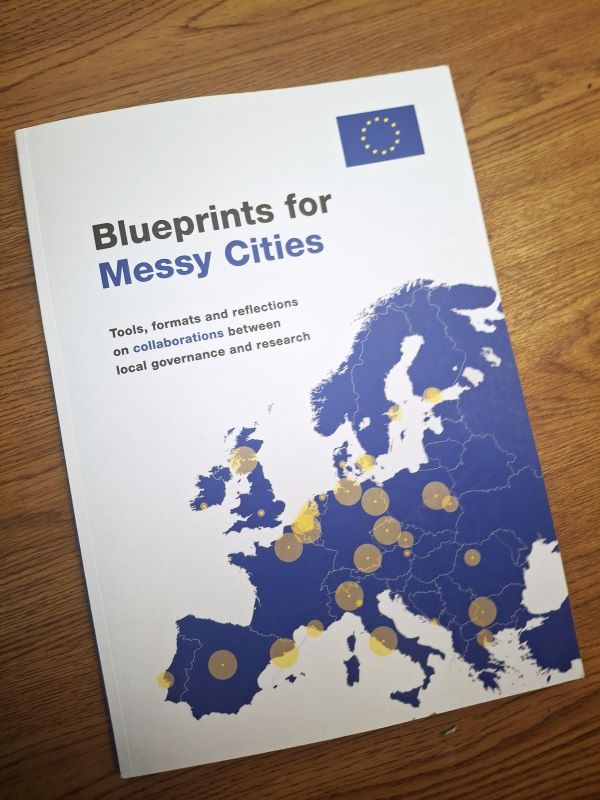
Blueprints for Messy Cities: Tools, formats and reflections on collaborations between local governance and research is the fourth report from the City Science Initiative, bringing together essays from researchers, city officials and civil society representatives across Europe. The collection focuses on scaling up the Initiative's reach and impact, with case studies drawn from cities where academic researchers and local government professionals have worked side by side to address real urban challenges.
The City Science Initiative is currently chaired by Professor Maria J Arche, who co-edited this fourth report alongside Peter van der Maas. The Institute has been an active participant in the network since 2024, and it's work with the Royal Borough of Greenwich is featured in the report.
In the report introduction, Professor Arche sets out the Initiative's relevance to this moment. At a time when disinformation and scepticism are on the rise, she writes that "science and evidence-based knowledge are coming back to reclaim their position as the best way known to bring effective solutions to the challenges we face."
A typology of collaboration formats for city-science partnerships
Professor Arche co-authors a chapter with Emma Clements of the Royal Borough of Greenwich, Aiysha Qureshi of the London Research and Policy Partnership, and colleagues from the City of Paris, which sets out a typology of collaboration formats for city-science partnerships. The chapter, titled "From Insight to Infrastructure," maps the spectrum of ways in which cities and universities can work together — from student projects and scientific advisory boards through to embedded researchers, co-production labs and long-term institutional partnerships — and reflects on how to match the right format to the right challenge.
The chapter draws in part on the experience of the University of Greenwich and the Royal Borough of Greenwich, whose collaboration is held up as an example of how a Memorandum of Understanding between a university and a local authority can provide the foundation of trust needed to sustain meaningful, long-term co-creation.
Youth justice as a model for multi-sector collaboration
The Royal Borough of Greenwich also contributes a case study to the report's yellow pages section, written by Emma Clements, which examines how the Institute has supported a multi-level approach to youth justice in the borough — one that draws together a broad range of stakeholders from across sectors.
As Clements writes in the report, youth justice offers "an unparallelled testing ground to identify blind spots, explore cooperation across sectors, establish common agendas leading to impact and assess how multi-disciplinary research findings can improve practice."
The Royal Borough of Greenwich's involvement with the University of Greenwich grew out of interest in a study funded through COST (European Cooperation in Science and Technology), also led by Professor Arche. That research focuses on assessing the language abilities of children and young people when they enter justice systems across a range of countries.
Reflecting on the value of the partnership, Clements notes that "initiatives that support community and public sector engagement in research make an impact for residents in the municipality and are possible only through the collaboration with researchers."
Looking ahead
The City Science Initiative calls for city-science partnerships to move beyond individual projects towards structured, long-term governance models with universities and local authorities working more seamlessly together. For the Institute and the Royal Borough of Greenwich, the work described in Blueprints for Messy Cities reflects an ongoing and deepening relationship, with further collaborations already underway spanning arts research, design, and criminal justice. As Professor Arche sets out in the report's introduction, the ultimate goal is to make "organic collaboration between researchers and cities the paradigm by default" and the Greenwich partnership offers a working model of what that can look like in practice.
The full report is available open access at https://doi.org/10.5281/zenodo.19665976.
About the Institute for Inclusive Communities and Environments
The Institute for Inclusive Communities and Environments at the University of Greenwich fosters interdisciplinary research that enriches lives, empowers communities and improves the world. Drawing on expertise across the arts, humanities and social sciences, the Institute works collaboratively with communities, organisations and policymakers in the UK and internationally to address the social and environmental challenges of our time — from inequality and social justice to sustainable cities, health and wellbeing, and the protection of natural ecosystems. The Institute is home to six research centres each bringing together researchers from different disciplines to tackle complex real-world problems.The Institute is part of the Faculty of Law, Arts and Social Sciences at the University of Greenwich. For more information, visit www.gre.ac.uk/las/ice.