Key details
Alex Bruno
PhD Student, PGRTA
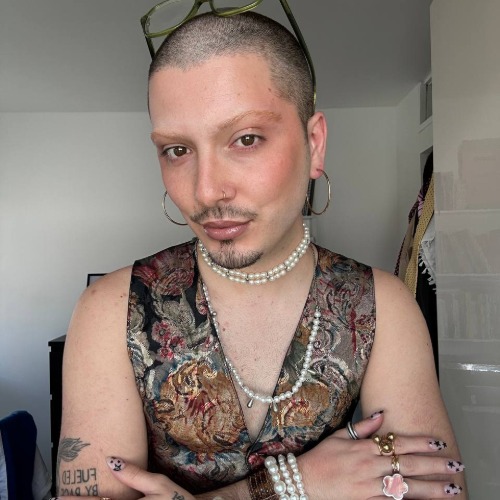
Alex Bruno (they/them) is a queer trans non binary activist, researcher, community organiser and fat rights advocate with the Italian fat liberationist collective Grassi Diritti. Alex is a PhD Student at the University of Greenwich with a doctoral project on “Imagining FAT Utopias: FAT Worldmaking and Collective Resistance Among FAT Workers”. The project explores how the medicalisation of fatness, the framing of fat people as unproductive, contemporary debates surrounding GLP-1 medications, and the lack of legal protection for fat workers shape the lived experiences of fat workers in the UK. Their academic work focuses on the experiences of participatory and collaborative methodologies, sex workers and fat peoples rights, and subversion of the medicalisation of fatness. They hold a Bachelor of Arts in Sociology and a Master in Applied Criminology from the University of Greenwich.
Responsibilities within the university
PhD Student
PGRTA in the Faculty of Law and Criminology
Awards
ESRC UBEL DTP 2025-2029
Research / Scholarly interests
My research interests developed through engagement with sex work research and have progressively expanded into fat studies and social justice. Since my BA, I have examined the lived realities of marginalised workers, beginning with my undergraduate dissertation on student sex workers’ experiences in university classrooms, which was later published. I then completed an MA in Applied Criminology, where my dissertation focused on the experiences of fat sex workers, exploring stigma, regulation, and labour precarity through a fat liberationist lens. I am now undertaking a PhD examining the experiences of fat workers within the UK workforce. My work critically interrogates the medicalisation and pathologisation of fatness, particularly in relation to the rise of GLP-1 drugs, and considers how these processes shape labour conditions. Alongside my PhD, the research with the fat liberationist collective Grassi Diritti aims at identifying the intersection of fat justice and reproductive justice, including abortion and contraception access, pregnancy care, fertility treatment, and gender-affirming healthcare. Methodologically, I adopt participatory and community-informed approaches, ensuring that research is accountable to those whose lives it examines. My broader scholarly interests include queer studies, epistemic justice, and the politics of knowledge production in academia.
Key funded projects
"Imagining FAT Utopias: FAT Worldmaking and Collective Resistance Among FAT Workers", ESRC UBEL DTP Main Scholarship 2025-29
"Fattening Abortion Care: Evidences, Experiences and Practices. A report by Grassi Diritti and Aborto in Pillole in collaboration with Women Help Women," funded by Women Help Women, 5000€, 2025-26
Findings:
- BMI functions as a covert governance mechanism in abortion access, operating as a form of hidden triage that is neither transparent nor evidence-based.
- When complications or increased clinical complexity occur, they are overwhelmingly linked to delays in access caused by fatphobic policies, referrals, and gatekeeping and not to fatness itself.
- Abortion pills (mifepristone and misoprostol) access doesn’t have to be limited based on body weight. Some people may experience a longer period of fetal expulsion and/or may require additional medication without any complications
- Independently to body weight, people can decide if they want to self manage their abortion or have abortion medication with professional support.
- Further research is urgently needed to produce more accurate and reliable data and better care; such research must explicitly address fat stigma and the structural barriers fat people face within healthcare systems.
- Fat people experience compounded forms of discrimination in reproductive healthcare, particularly due to medical practitioners’ lack of training in working with fat bodies and the gatekeeping of information from patients. In case of late gestational age or if a person specifically requests surgical abortion. We believe it requires particular attention in future research. Current recommendations often suggest that medical abortion with pills is safer, partly due to alleged anaesthetic risks in surgical procedures.
- While we agree that medical abortion can be safer in practice, especially because it involves less contact with fatphobic medical staff, we strongly contest anaesthesia-based justifications. These concerns are not evidence-based but reflect inadequate training and systemic fatphobia: longer needles exist, staff can and should be trained, and anaesthetic teams routinely provide care for fat patients in bariatric surgery, yet this expertise is often disregarded when fat people seek other forms of care.
Recent publications
Bruno, A. (2025) “Classroom Safety for Student Sex Workers: A Case Study at the University of Greenwich”, Compass: Journal of Learning and Teaching in Higher Education, 17(2). doi: 10.21100/compass.v17i2.1563
Presentations
2026 “Corpi Grassi e Lavoro Sessuale” Conferenza Grassa 2026, Grassi Diritti, Italy.
2025 “Fat Bodies and Sex Work” IDESVAW Sex Workers Symposium 2025, University of Nottingham, Nottingham. / 2025 “Fattening Social Sciences” UBEL Student Conference 2025, Institute of Education, London.
2025 “Radical Listening as Fat Liberationist praxis: Peer-to-Peer support in Reproductive Justice” London Conference of Critical Thought, Online.
2025 “Fat Liberation, Reproductive Justice, and Grassroots Research: The Work of Grassi Diritti” The Postgraduate Showcase 2025, University of Greenwich
2025 “Students and Sex Work: in conversation with Dr Helen Rand, Dr Jessica Simpson and Alex Bruno” Oxford University
2024 “Students and Sex Work at the University of Greenwich” 04 November 2024. “Sexifier: Bringing together SWERS, academics, & allies for SW research that matters” UCL London
2024 “I don’t want them as my friends!”: Investigating Classroom Safety for Student Sex Workers. 29 June 2024. London Conference of Critical Thought. London / 2024 “Students and Sex Work” 27 June 2024. AMOOSHE (Student Services) Conference, Glasgow