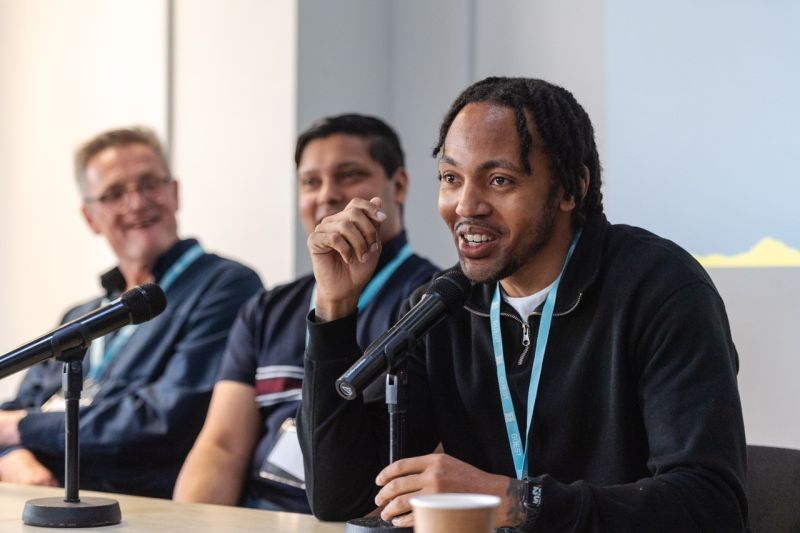
After graduating from his PGCE programme at the University of Greenwich in 2021, Ryan Carty recalls the significant role his tutors played in helping him build the foundations for his career. “Since graduating, my career has taken turns I never expected, and part of this, I attribute this to the confidence I developed at Greenwich. Lecturers at University of Greenwich were instrumental in helping me identify how I wanted to create impact,” Ryan reflects. “They helped me at the start of a career transition I needed to make to pursue more purposeful work, where I could be myself. This is a large part of why I now work with vulnerable young people and advocate for systems change in this area.”
Overcoming barriers in education for Ryan went far beyond the classroom. He’d experienced various challenges in childhood and early adulthood including family and individual homelessness, exploitation, mental health, domestic abuse, serious youth violence and late diagnosed learning disabilities. “Many have had far worse situations than me but as a black male from South London, the journey in education spaces has been challenging for reasons related to race and much more. Ultimately, my struggles after leaving school escalated due to a lack of trusted adults around me.”
Ryan’s second place of study for FE resulted in him being excluded under what he and many others considered unjust and questionable circumstances including having his grades capped from DMM to PPP. This was not long after being diagnosed with learning needs. With this diagnosis, Ryan hoped enrolling for an undergraduate degree would be a fresh start. His exclusion meant he could only apply for three universities through clearing, so frustratingly, he ended up five hours from home and had to undergo a foundation year, adding another year of study. Although this wasn’t always the case, unfortunately, supportive lecturers were scarce. “One lecturer complained about me combining paid work and studying without understanding why,” he recalls.
Ryan encountered a similar pattern during his MA. “A lecturer questioned if I was in the right place even after seeing my student badge. Microaggressions, biases and a lack of understanding about neurodivergence often left me feeling misunderstood by staff from privileged, predominantly white, backgrounds who often underestimated the effort it took just to be present.”
“Greenwich, by contrast, was different to other higher education institutes I studied at,” Ryan recalls. “Studying at University of Greenwich - even during the COVID pandemic - was transformative. The lecturers treated me like a human being and saw the best in me even on my difficult days. Tutors understood my circumstances allowing flexibility with lectures while working in a specialist education school, both in person and online, as long as I was in constant communication and up to date with work.” Ryan believes that this awareness of his financial and personal challenges prevented him from disengaging from his PGCE.
Returning to South London too at 25 years old after eight years away also felt like a full circle moment for Ryan. “Growing up across South London gave me a strong connection to Greenwich. I was born and lived in Southwark, lived in different parts of Lewisham and Bromley, and for a short time in Lambeth with strong connections to the area as my dad’s side of the family are from here. South London has always been central to my identity.”
Today, Ryan works for Westminster City Council’s Changing Futures Programme, leading the Artemis Project which aims to improve outcomes for people aged 18-30 facing multiple disadvantages (including homelessness, domestic abuse, criminal justice involvement, substance misuse and mental health) being released from custody. Alongside this, Ryan is the co-chair of the Race Equality and Research Implementation Group for British Universities & Colleges Sport and a relationship education workshop facilitator for the Let Me Know charity. He also co-founded the Empowering Young Champions (EYC) Project, a family-run community interest company supporting 12-25-year-olds experiencing multiple disadvantage. EYC is also his mother’s initials, paying homage to the support she gave him and his siblings through challenges.
“The class I taught in my first teaching job after completing the PGCE produced more than ten students going onto university, including many who had previously struggled experiencing things like exclusions, alternative provision, or were in care. Ultimately, many were written off by the system - just as I and many friends and family were. With the correct support, these young people are now flourishing in adulthood thanks to guidance and support beyond the classroom, something my Greenwich tutors actively encouraged me to provide. They recognised I could see young people for more than their academic capabilities and encouraged me to lean into this. I have since hosted three lectures at Greenwich to trainee teachers on this topic.”
Ultimately, Ryan’s experience at Greenwich has continued to inform and shape how he supports young people today. “My PGCE at Greenwich showed me that there are experienced professionals that think similarly to me. This gives me permission to be myself despite being discouraged to do so by many. These lecturers valued my authenticity and essentially helped me understand this is one of many skills I have when it comes to supporting young people.”
Ryan has delivered over 100 workshops, and guest talks to over 1,000 young people and professionals, led programmes and coached at risk young people in some of the most challenging environments in London, Essex and Manchester. “Much of this success stems from having permission just to be me,” he notes.
“The University of Greenwich balanced professionalism while maintaining human connection. This approach showing that you can be yourself and still thrive is a lesson that continues to shape how I support young people today.”
Find out more or apply here.