Key details
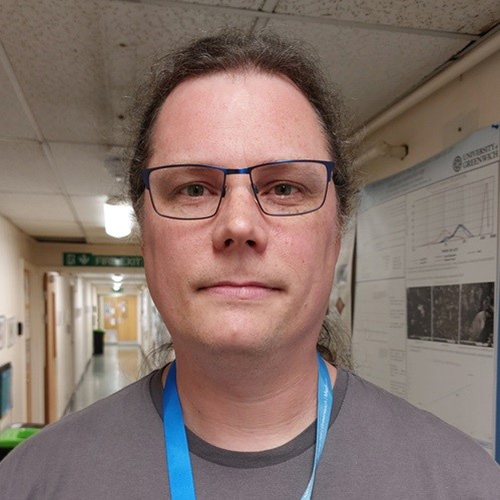
Dr Ewan R Clark
Senior Lecturer in Chemistry
Dr Clark did his Masters with Dr Alex Hopkins at the University of Cambridge on organosilicon chemistry and has remained fascinated with the main group ever since. He completed his PhD in 2008, working with Professor Jeremy Rawson on S/N heterocyclic radicals, again at Cambridge, before moving to Newcastle University in as a PDRA working with Dr Keith Izod on tetrylene chemistry followed by another post-doc at the University of Manchester in 2011 with Professor Mike Ingleson on boron superacids and frustrated Lewis pair (FLP) catalysis.
He began his independent career at the University of Kent in 2014, promoted to Senior Lecturer in 2018, and then moved to the University of Greenwich in 2024. His research focusses on low-valent and low-coordinate main group species as new, earth abundant catalysts, with a particular emphasis on phospha-cations.
Responsibilities within the university
Dr Clark teaches across the physical, inorganic, and analytical courses within the School of Science.
Research / Scholarly interests
Dr Ewan Clark’s research interests lie in uncovering and exploiting the properties, both chemical and material, of main group elements with unconventional geometries, oxidation states, or charges. Much conventional catalytic activity associated with transition metals derives from their versatile coordination environments and multiple stable redox states. Nevertheless, this chemistry is not unique to the transition metals and opening up the analogous p-block chemistry will develop not only new and complementary applications, but also show hitherto unobserved properties.
The group expertise lies in the synthesis and handling of highly reactive compounds using inert atmosphere techniques and their characterisation in both solid state and solution by diffraction and spectroscopic methods. These studies are then coupled with computational studies to derive complete structure-property relationships which in turn allow both a deeper understanding of the fundamental behaviour of the systems and form an iterative feedback loop to design and deliver compounds with useful properties.