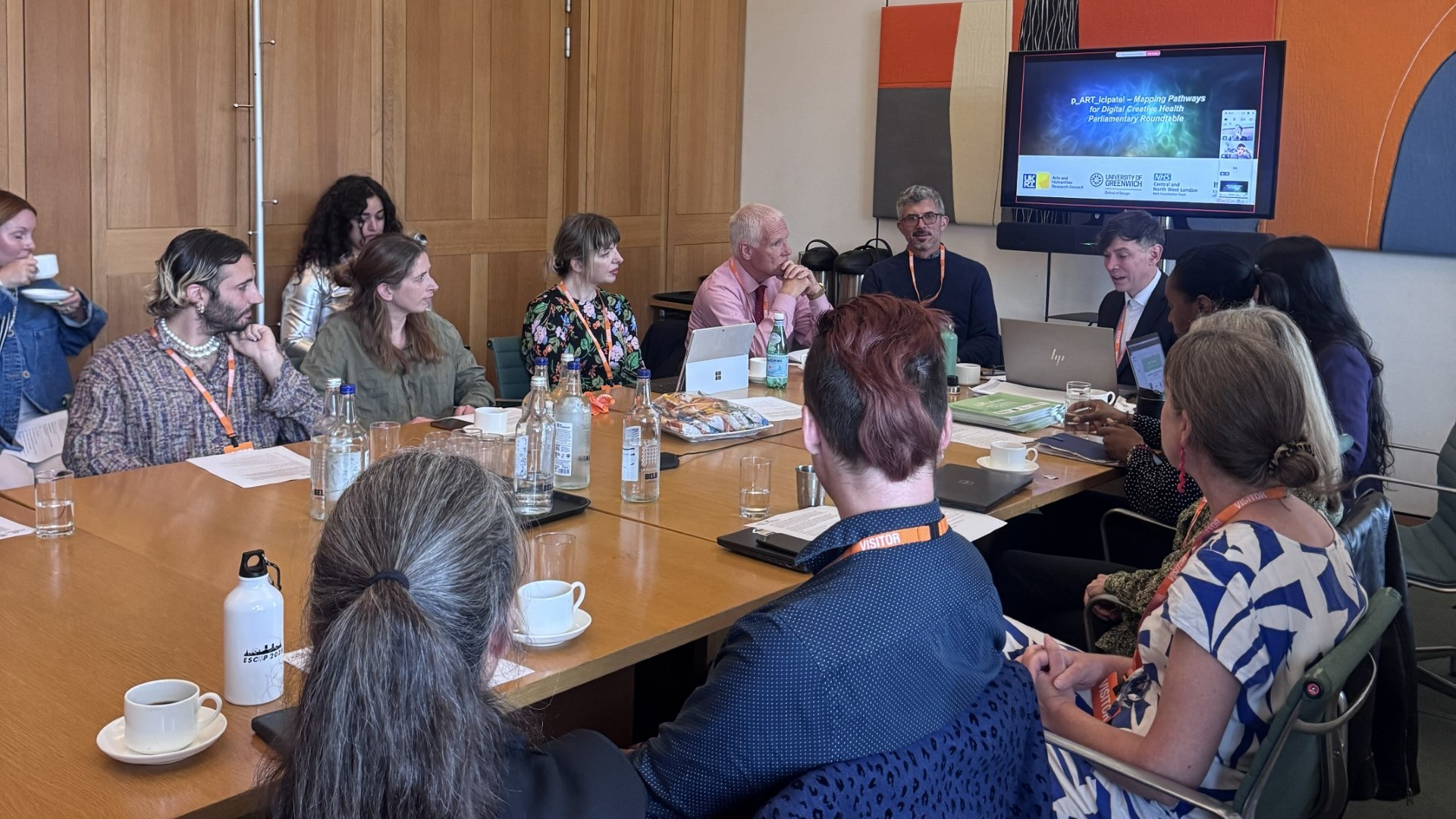
A new parliamentary report involving researchers and partners from the University of Greenwich, Brunel University London, Central and North West London NHS Foundation Trust and Policy Connect sets out recommendations for clearer policy, stronger regulation and greater community involvement to support the growth of digital creative health across the UK.
Published following a series of roundtables organised in collaboration with the All-Party Parliamentary Health Group (APPHG), Mapping Pathways for Digital Creative Health brings together insights from researchers, NHS leaders, policymakers, creative practitioners and people with lived experience to identify the opportunities and challenges facing this rapidly developing field.
Digital creative health refers to participatory arts delivered through technologies such as virtual and augmented reality, sensor-based platforms and AI-assisted applications. The report highlights growing evidence that arts-based activities can support mental and physical health, while digital delivery can widen access for people affected by distance, mobility barriers or social isolation. At the same time, the sector faces significant challenges around regulation, data governance and the adoption of innovative approaches within healthcare systems.
"We would like to see digital creative health clearly defined within the policy space and reflected within regulatory frameworks, including future developments around the Data Use and Access Act. We would also like to see co-design become a requirement within funding structures, so that people with lived experience are not treated as an afterthought but recognised as active partners in development" said Dr Oliver Mag Gingrich of the University of Greenwich, one of the report's authors
The report was developed through the p_ART_icipate consortium, an AHRC-funded initiative exploring ethical, accessible and inclusive approaches to digital creative health. Building on an earlier roundtable on standards, ethics and accessibility held in November 2025, discussions focused on four key themes: regulation and data ethics; digital infrastructure, accessibility and co-design; adoption pathways for communities, practitioners and SMEs; and culture change, higher education institutions and the skills gap.
The resulting recommendations have since been shared with more than 20 MPs and, through the APPHG, with Number 10, helping to bring digital creative health into wider policy discussions.
A central message running throughout the report is that people with lived experience must play a meaningful role in shaping digital creative health initiatives. The authors argue that co-design should be embedded throughout projects and become a condition of public funding, ensuring communities are active participants rather than being consulted only at the final stages of development.
The work also reflects the University of Greenwich's longstanding commitment to participatory practice, inclusion and civic engagement. Researchers worked closely with partners from across the creative health, technology and healthcare sectors, alongside people with lived experience whose perspectives helped shape discussions and recommendations.
"University of Greenwich has a long-standing commitment to participatory practices, inclusivity and human-centred design. What really helps is our proximity to industry and our ability to work across sectors to understand the wider ecosystem and how it can be transformed. We are also strongly committed to civic engagement, and in south-east London there is a vibrant creative health ecosystem that has played an important role in supporting this conversation." - Dr Gingrich
Looking ahead, the report identifies four priority areas for action: establishing clearer policy and regulatory frameworks for digital creative health; embedding co-design and lived experience in funding and governance; creating more transparent adoption pathways for innovation within health systems; and developing evaluation approaches that capture long-term and community-level impacts.
Dr Gingrich added: "There is a huge amount of innovation taking place, but there is still a lack of clarity around how these innovations can be adopted and embedded within healthcare systems. At the same time, we need more meaningful approaches to evaluation that can capture long-term impact and allow projects to be compared and understood more effectively."
As conversations continue across government, higher education and the NHS, the report provides a framework for ensuring that digital creative health develops in ways that are inclusive, ethical and shaped by the communities it seeks to serve.
Read the report
The report was authored by Dr Oliver Mag Gingrich (University of Greenwich), Claire Grant (Central and North West London NHS Foundation Trust), Professor Dominik Havsteen-Franklin (Brunel University London) and Claudia Jaksch (Policy Connect).
The full report, Mapping Pathways for Digital Creative Health: P_ART_ICIPATE! APPHG Report and Recommendations, is available on Zenodo: Read the full report