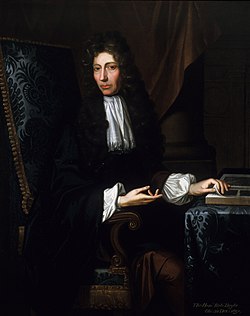
 Robert Boyle (1627-1691) was born in County Waterford as the seventh son of the earl of Cork. He educated at Eton and later studied in Europe. He returned from the continent in 1644 extremely interested in science and settled in Dorset where he built a laboratory. In 1655 or 1666, Boyle moved to Oxford, where he worked with Robert Hooke and devised the most famous piece of experimental equipment associated with Boyle, the vacuum chamber or air-pump.
At this time even the idea of an experiment was controversial. The established method of 'discovering' something was to argue it out. Boyle was the first prominent scientist to perform controlled experiments and publish his work with details concerning procedure, apparatus and observations. He began to publish in 1659 and continued to do so for the rest of his life on subjects as diverse as philosophy, medicine and religion. His best‑known contribution is Boyle’s Law, describing the inverse relationship between gas pressure and volume.
In 1660, together with 11 others, Boyle formed the Royal Society in London which met to witness experiments and discuss what we would now call scientific topics. In 1668, Boyle moved permanently to London, living with his sister. In 1680 he refused the presidency of the Royal Society because the oath required violated his strongly held religious principles. Boyle died in London on 31 December 1691.
Source: Robert Boyle | Science Museum Group Collection
Image credit: Portrait by Johann Kerseboom, 1689