About the APT project
Building on the success of the National Student Survey (NSS) Taskforce, which contributed to the University achieving 45th place in the Times Higher Education rankings, the Academic Programme Taskforce (APT) takes a broader, programme level approach to student success.
APT brings together NSS results and wider Student Success metrics, including Continuation, Graduate Outcomes and the BAME Awarding Difference, to identify strengths, target interventions, and support collaborative action across the University.
Aims of the APT
- Provide a holistic view of programme‑level performance
- Enable coordinated, evidence‑led interventions
- Support collaboration between academic teams and professional services
- Enhance academic quality and the student experience
Performance thresholds (overview)
The following thresholds are used to assess programme performance across NSS and Student Success metrics and are reviewed annually:
| Metric | Green rating | Amber rating | Red rating |
|---|---|---|---|
| NSS | ≥88% | 78.6-87.9% | ≤78.5% |
| Continuation | ≥90% | 80.0-89.9% | <80% |
| Graduate Outcomes | ≥80% | 60.0-79.9% | <60% |
| BAME Awarding Difference | ≤5% | 5.1-14.9% | ≥15% |
Programme categorisation
Programmes are grouped into one of four categories based on their overall performance profile:
| Programme category | What this means |
|---|---|
| Good practice | Strong performance across NSS and Student Success metrics, with examples of effective practice to share. |
| Middle | Mixed results across metrics. These programmes receive targeted faculty‑led support. |
| Taskforce | Programmes identified as priorities for central, coordinated intervention and enhanced support. |
| Programmes for targeted improvement | Strong overall performance in NSS, with faculties retaining primary responsibility and central support engaged only where a red indicator in a student success metric is identified. |
Key timeline
- July - August: NSS results published and programme categorisation confirmed
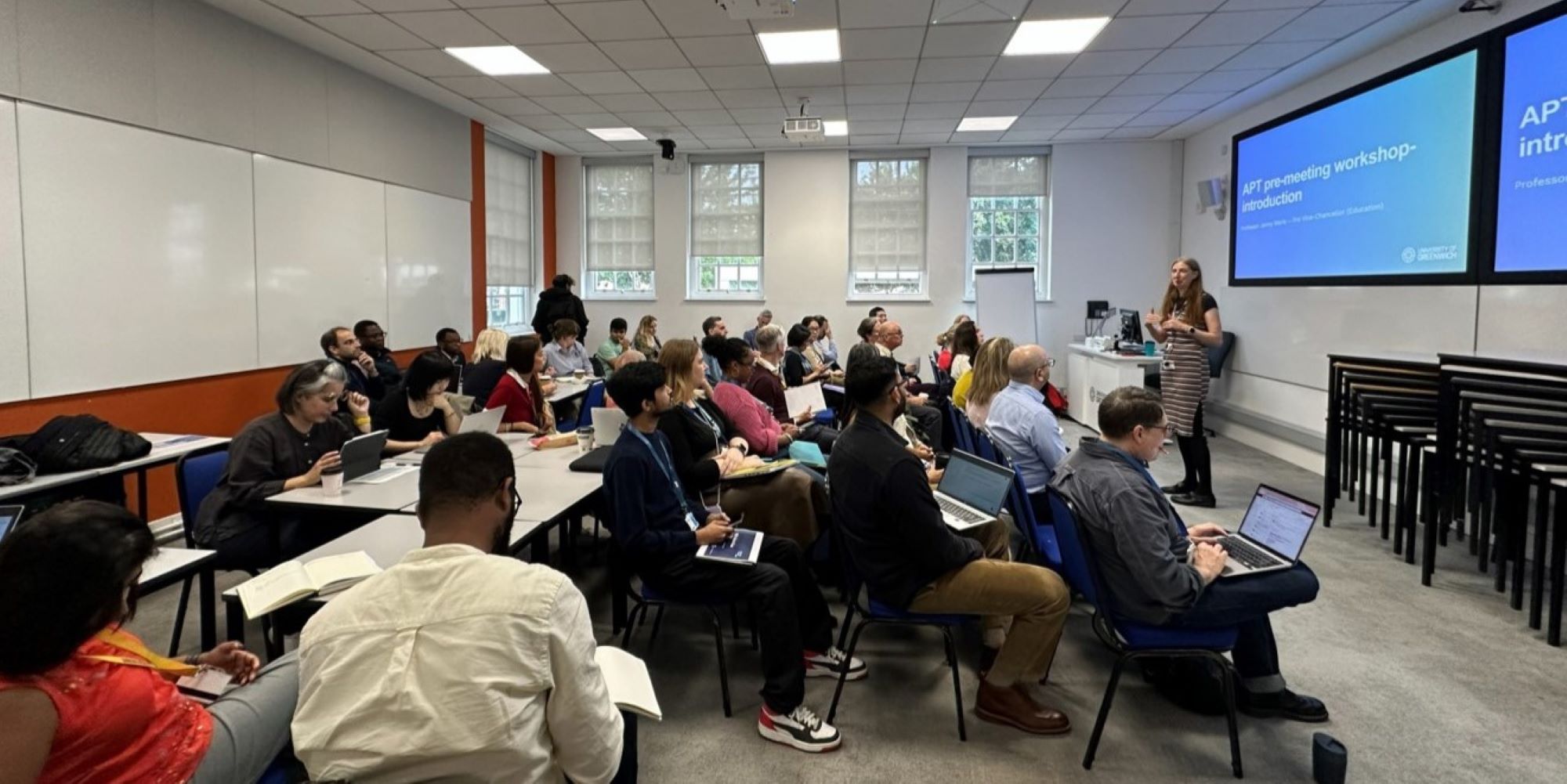
- September: APT action planning workshop and taskforce meetings begin
- October - November: Targeted support, faculty-led discussions for the Middle programmes and Good Practice sharing
- November: Student Success Awards Ceremony - recognition of good practice
- January: Mid-term review and impact evaluation
Full documentation, including detailed metrics, categorisation logic and timelines, is available in the APT Briefing Pack.



FAQs
These FAQs provide guidance on the APT process, participation, and data. They are intended for programme teams and faculty colleagues involved in the Academic Programme Task Force (APT).
APT processes and requirements
Do thresholds change each year?
Yes. Thresholds used to categorise programmes are reviewed annually to reflect the latest NSS results.
Does the taskforce membership change each year?
Yes. Taskforce membership is reviewed annually; however, core membership, including Faculty Leadership, Heads of School and Programme Teams, remains unchanged, while other membership may vary depending on focus areas.
Do I need to submit an action plan before the taskforce meeting?
Yes. Programme teams are required to submit an action plan in advance of the taskforce meeting. The action plan must be approved by the PVC and Executive Dean and submitted on CIT to the Student Success Project Officer at least three working days before the taskforce meeting.
What happens after the taskforce meeting?
Once the action plan has been approved at the taskforce meeting, the programme team is expected to implement the agreed actions. Faculty leadership will monitor progress throughout the year, and a mid-year review meeting in January provides an opportunity for programme teams to report on progress and discuss any next roadblocks to be addressed.
Participation and logistics
Who should attend APT meetings?
APT meetings are attended by the Programme Leader, Head of School, and relevant Faculty leaders, and are chaired by a member of the senior management team.
Other colleagues involved in the area under discussion are also welcome to attend. Attendees should come prepared with an understanding of the programme's key issues and proposed actions.
What if a taskforce meeting clashes with my teaching?
Taskforce meetings are a core part of the APT process and in‑person attendance is required to enable senior leadership to support and address programme issues effectively.
If a meeting clashes with your teaching, please contact the Student Success Project Officer as early as possible to discuss adjusting arrangements.
Are APT workshops compulsory, and can module leaders attend?
APT workshops are compulsory for Programme Leaders of targeted programmes.
Heads of School may also decide whether other programme team members, such as module leaders, should attend where this would support programme improvement.
Data and metrics
Is the data on CIT (e.g. NSS, Continuation, Graduate Outcomes, BAME Awarding) up to date?
Data on CIT is updated as it becomes available. As datasets are released at different points in the year, the latest data may not be visible at the same time. Indicative release timings are outlined below:
NSS: End of July
Continuation: December
Graduate Outcomes: April
BAME Awarding Difference: December
How is NSS data defined?
The full NSS dataset is published by the Office for Students in July.
For APT categorisation and internal benchmarking, the final NSS score is calculated by averaging results from:
- Teaching on My Course
- Assessment and Feedback
These measures align with those used in the Guardian University League Table.
How is continuation data defined?
Continuation is the proportion of students who are active and enrolled with no holds on the 1st December in their first year, who are also active and enrolled with no holds one year later. The minimum cohort size for the continuation metric to be rated is 25 eligible first-year students. This definition is used across CIT, Faculty Planning Rounds and the APT, but differs from OfS continuation figures.
Based on this definition:
- Withdrawal to another university: Not continuing
- Dropout: Not continuing
- Resitting students: Continuing (if active and enrolled on 1 December)
- Repeating Year 1: Continuing (if active and enrolled on 1 December)
- Switching to part time: Continuing (if active and enrolled on 1 December)
- Changing programme: Continuing (if active and enrolled on 1 December)
How is the Graduate Outcomes defined?
Graduate Outcomes is a national survey conducted by the Office for Students that captures graduates’ activities 15 months after completion, including employment, further study, and the relevance of these activities to their degree. A positive Graduate Outcome is when a graduate is in highly skilled employment (SOC major groupings 1-3) or further study 15 months after completion. Graduates who are on long term travel, have significant caring responsibility or are retired at the point of survey are also considered to have positive outcomes. This aligns with the OfS Progression definition.
The data supports programmes in understanding graduate progression and identifying areas to enhance employability preparation. For APT purposes, programmes with fewer than 10 survey responses are excluded.
How is the BAME Awarding Difference defined?
The BAME Awarding Difference measures the gap in degree outcomes between White students and Black, Asian and Minority Ethnic (BAME) students, this is calculated as White Awarding Rate – BAME Awarding Rate.
It is used to identify disparities in student achievement and support targeted actions to improve equity and inclusivity. Reporting requires a minimum cohort size of 20 BAME students and 20 White students in the final year.
Where can I find my programme’s latest data?
All programme‑level data is available via the Continuous Improvement Tool (CIT), which provides a single platform for accessing data and managing action plans for UG programmes.
What graduate outcome data is helpful when developing actions?
Key sources of graduate outcomes and employability data include:
- Career Registration Platform
A university‑wide career planning survey system with reporting dashboards in the Staff Portal, providing aggregated data on student career aspirations and readiness.
For guidance, please visit our Moodle course.
- Target Connect
The university’s online careers and employability platform, providing insight into student engagement with careers services. Visit Target Connect.
Why are there no student comments for my programme in the NSS?
Student comments are only published where the minimum threshold of 10 survey responses is met.
Good Practice and classification
Can a programme still be “Good Practice” if only the UGIC/extended version is classified as such?
No. UGIC and extended programmes are not classified as “Good Practice” independently. Classifications are made at the level of the main programme. If only the UGIC or extended version meets the “Good Practice” criteria, this would not result in the overall programme being classified as “Good Practice.”
Where can I find examples of Good Practice?
Programme teams are encouraged to learn from Good Practice Programmes across faculties, which demonstrate strong performance in key NSS themes such as:
- Teaching on My Course
- Assessment and Feedback
- Organisation and Management
- Academic Support
Case studies and videos are available via the Learning, Teaching and Resource Centre (LTRC).
Latest articles
Still have a question?
If your question is not covered here, please contact the relevant team listed in the Contact and Enquiries section.