The university has a Green Travel Plan covering all three campuses. This aims to promote green travel through various initiatives.
Key highlights
- Zero & low carbon buses & coaches
- The first university to operate electric double-deck buses dedicated to students & staff
- Ambitious target to reduce our business travel emissions 50% by 2027
- Car park revenue reinvested into the Green Travel Plan
- Cycling facilities & Dr Bike maintenance events
- Cycle to work & electric vehicle salary sacrifice schemes for staff
- Electric vehicle charging points for students & staff use
- Regular travel surveys to track preferences & progress
- Enhanced car share scheme
Our Transport Plan helps enable staff and students to reduce their car dependency, by using alternative, healthy, and low carbon options. Click here for travel information about how to get to our campuses.
A travel plan aims to reduce car use and increase sustainable modes of transport (walking, cycling and public transport) but the benefits go beyond the environment and extend to health, fitness and wellbeing. Online IT systems now enable remote working reducing the need for travel. The below travel hierarchy illustrates how we should consider each travel mode.
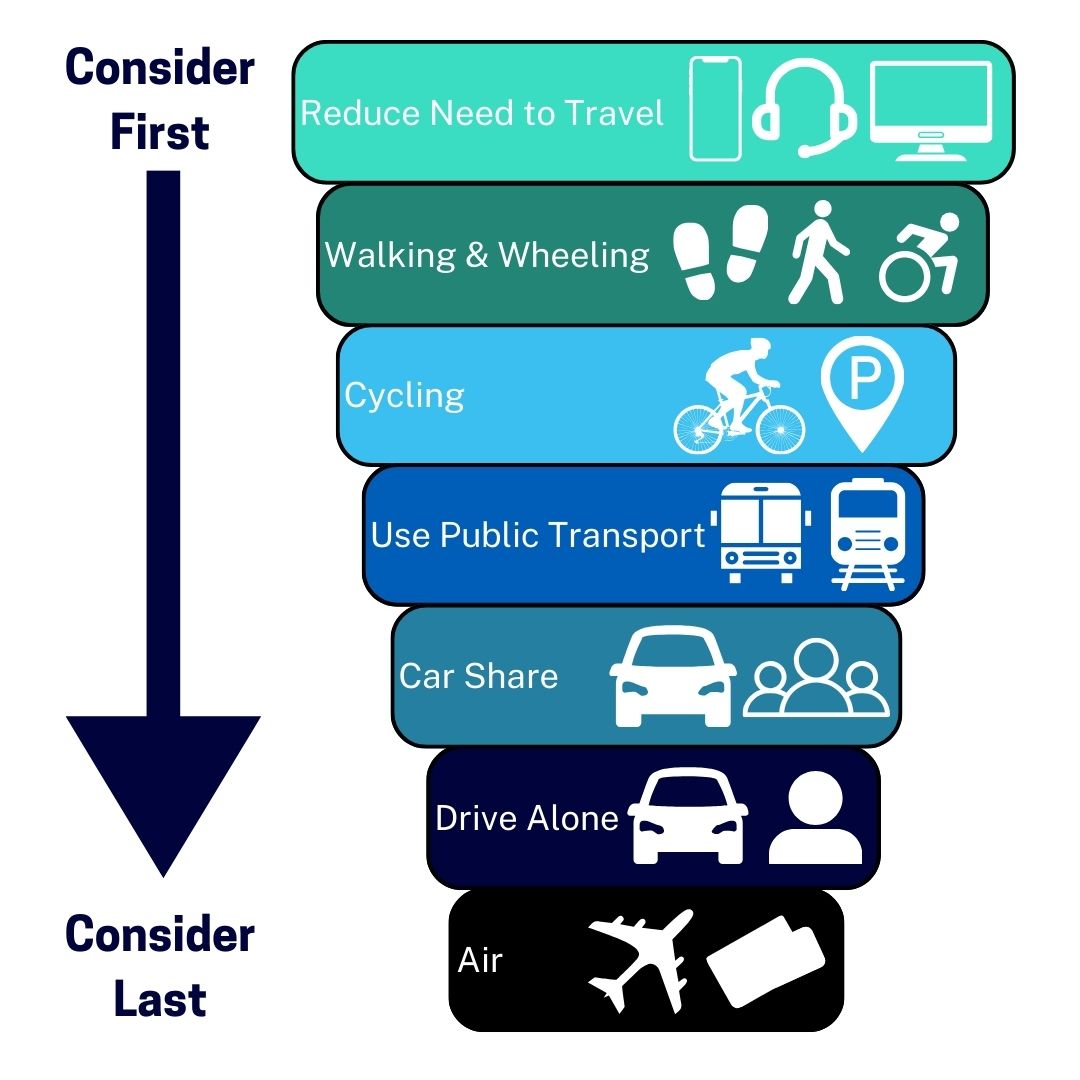
The Transport team surveys the commuting habits of staff and students to better understand modal split and calculate the Scope 3 Carbon emissions from these activities. This is published with the Annual Sustainability Report and contributes towards our total carbon footprint analysis. Solutions to unsustainable travel will continue to evolve and will be required beyond the current life of the Green Travel Plan.
Carbon Benefits in Using Our Transport Services
- Avery Hill to Greenwich - by taking our bus service instead of driving you are saving 1.5kg of carbon emissions per journey! It would take a large oak tree 1.5 months to absorb this amount of carbon! Thank you for using these buses. Do not forget that two of these buses are fully electric and we are one of the first institutions providing this service upgrade.
- Avery Hill to Medway - by taking our coach service instead of driving you are saving 5kg of carbon emissions per journey! It would take a large oak tree 5 months to absorb this amount of carbon! Thank you for using these coaches.
- Medway to Greenwich - by taking our coach service instead of driving you are 8kg of carbon emissions per journey! It would take a large oak tree 7 months to absorb this much carbon! Do not forget that two of these coaches are hybrid, saving 5 miles per gallon each journey (13mpg compared to 8mpg under the diesel vehicles).
Assumptions and Calculations of Our Transport Benefits
- Savings calculated for a single bus/coach trip against driving a car alone (route distances are 6 miles Avery Hill to Greenwich; 23 miles Avery Hill to Medway; and 30 miles Medway to Greenwich).
- Car has average UK emissions of 167g of carbon dioxide per kilometre.
- Avery Hill – Greenwich bus is an Optare Metrodecker electric with zero emissions.
- Greenwich – Medway coach is a 57-seat Irizar i4H diesel hybrid, travelling an average of 24 miles per gallon of diesel (average biofuel blend), with an average 75% passenger occupancy.
- Avery Hill – Medway bus is 22-seat Iveco diesel minibus, travelling an average of 20 miles per gallon of diesel (average biofuel blend), with an average 50% passenger occupancy.
- Oak tree average is growing in the British Isles for 50 years measuring 20cm diameter at breast height with average sequestration of 13kg carbon dioxide per year including above and below ground biomass.
- Value based on averaging roughly equal sequestration estimates based on
- i) the National Forest Inventory on carbon stocks (NFI, 2018) where Oak accounts for 31 million tonnes of carbon and 15-20cm is the most common diameter grouping.
- ii) allometric equations from Krejza et al (2017) which relate diameter and height to carbon stocks.
- Assumed tree will reach this at 50 years based on growth curve data published in Short (2013). Many trees will take longer (80-100 years) to accumulate this much carbon.
Sequestration data and calculation provided by Conor Walsh (UoG Natural Resources Institute)
NFI, 2018. Preliminary findings of the extent, composition, health and nature of woodland oak in Britain. National Forest Inventory, Forestry Commission
Krejza, J., Světlík, J. and Bednář, P., 2017. Allometric relationship and biomass expansion factors (BEFs) for above-and below-ground biomass prediction and stem volume estimation for ash (Fraxinus excelsior L.) and oak (Quercus robur L.). Trees, 31, pp.1303-1316.
Short, I., 2013. The potential for using a free-growth system in the rehabilitation of poorly performing pole-stage broadleaf stands. Teagasc.